
when you're in the business of manufacturing fear
by kurtis scaletta
 politics is not so much a science of managing public affairs as a science of managing public opinion. it is a craven business, where political machinery spends millions of dollars to tell people what to think, and then use public opinion polls to support their actions. a public relations firm was used, for instance, to label, merchandise and market desert storm with the same kind of hype used for summer movies and rock stars. the resulting public fervor was then used to argue the necessity of the war. more recently, such tactics were used to destroy nationalized health care. the insurance industry paid advertising agencies to create massive distrust for the program, which their eager servants in congress used to justify killing the program. (congressional leaders and their staffs, of course, have government-sponsored health insurance).
the manufacturing of public opinion works best when it takes on a mythic quality. the nightmare mythology of "the red menace" served for half a century as a vibrant mythology that could be used to tune real fears to a fever-pitch of paranoia, fomenting support for oppression at home and cruelty abroad. the dissolution of the soviet union, though gloated over in the media and republican punditry as a victory, has left the emperor naked. it is necessary to spin a new myth, and four out of five political parties favor crime as the new "menace" about which to invent a new nightmare. informed by sensational journalism, cops-like infotainment, cop and robber movies, childhood stories about the bogeyman, and the actual experience of victimization, americans are worried sick about crime. it is easy to tap this fear, in addition to the traditional american bloodthirst, latent racism, viprous xenophobia, and a basic penchant for feeling high and mighty, and develop a scenario of mythic proportions.
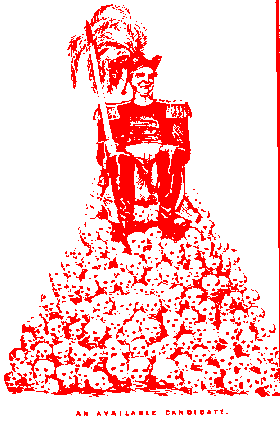 bob dole has made crime a hot issue in this campaign season, and promises it will get hotter and hotter in the next millennium. that bob dole is losing the battle for popular support is no indication that the myth has not captured the american imagination. it is simply that bill clinton has already co-opted the issue. dole desperately attempts to inspire us to believe that clinton's toughness is not as tough as his toughness, in the same way that kennedy once accused nixon of not being tougher against communists, but isn't charismatic enough to make it stick. a geriatric and cripple, bob dole doesn't look tough enough on television to wage a war on crime, but his understanding that fear of crime is a way to access the electorate is astute. harry browne and ross perot are also "tough-on-crime." of candidates pulling at least a percent in the poles, only ralph nader has not issued an "anti-crime" policy. the other four candidates, though differing on "solutions" to the problem, are in collusion in the use of crime as a way to manipulate public opinion. more than being a "hot issue" in the next millenium, crime promises to be the defining myth of the next political era.
the scenario of the myth is similar to the future-world described in h.g. well's the time machine, with it's big-eyed sunbathing vegetarian eloi and the subterranean carnivorous morlocks. the eloi would live in complete peace and harmony were it not for the evil morlocks who prey on them. in contemporary mythology, the "eloi" are "citizens of goodwill," and the morlocks are "criminals," the one-word reason for crime in the politico-spun mythos. dole and his conservative coterie, like the eloi and the morlocks in the tale, is willfully ignorant of the social roots of the division (found in chapter 5 of the novel). the pretty eloi and horrid morlocks are the (d)evolved descendents of the elite and lower classes.
in our story, the eloi protaganists (citizens of good will) must exercise any amount of cruelty to keep the morlocks in line--to be, despite their pampered eloi nature--a formidable opponent to the enemy. this is best achieved through a massive army of police officers, prison wardens, and border patrol guards. a third species, a morlockian temperment but in service to the eloi, is made to maintain eloian order. this may seem an offense to aesthetic principles of mythology, where the hero is traditionally david and not goliath, but americans have come to accept the mindless bully-hero, the rambo and terminator, just as they have come to accept america's mindless bullying of third world countries.
there are many practical ends for such mythmaking, one of which is not the creation of a safe and happy society for everyone:
1. for politicians, there is no risk in being anti-crime. everyone is "against crime," even sociopaths. prisoners at an arizona penitentiary cheered bob dole's anti-crime speech (of course they can't vote). there are no crime lobbies organizing grass-roots campaigns to fell tough-on-crime candidates, only unpopular civil liberties organizations, and a candidate can't lose votes by taking what is sometimes called "a courageous stance against crime."
2. as poverty increases, and social programs are cut, it is necessary for americans to fear and hate the poor. sympathy with the poor could sway nice people from the program of rich. there is tacit understanding that "poor crime" is the problem--hence the constant references to "streets" and "neighborhoods," the places where poor criminals do their business--and not white collar crimes, environmental crimes, and other misconducts of the wealthy (which fall more readily under the category of "deregulation" and "getting the government off our backs"--that is, crimes that should be made legal). dole's disingenuous position is that crime is not the result of social factors; at the same time "crime" and "poverty" are blurred.
3. anti-crime sentiment easy aligns itself with anti-immigration sentiment, manifest in the derisive slur, "illegals," for undocumented aliens; and aligns itself with xenophobia and the fear of terrorism. anti-terrorism and anti-immigration are essential parts of both dole's and clinton's anti-crime platforms. there is obviously little or no discussion of how either immigration or terrorism is connected to america's foreign policy, which is never cruel or brutal enough for the electorate. indeed, like crime, foreign policy has to be "tough," and the only debate is over who will be toughest.
4. anti-crime hysteria makes it easy to taint political opposition. to be "soft on crime," is seen as weak and cowardly (despite the obvious political courage and risk involved). just as "pinko" ideas were seen as anti-american and morally wrong, "soft-on-crime" ideas, such as a belief in criminal rights statutes or opposition to the death penalty, are construed as "anti-victim," that is, "anti-americans-with-goodwill," and morally wrong.
 5. the fear of crime distracts people from the crimes against humanity practiced by the u.s. and its allies, as well as crimes against man and nature practiced by corporate overlords.
6. citizens of goodwill will need more prisons and police officers to protect themselves from the poor, as well as more border patrol guards to protect themselves from the fleeing citizens of nations the u.s. has destroyed in latin america, asia, and africa.
more prisons, more police officers, and hostility towards offenders is a desperate, paranoid move that does not address the problems in american society that foster crime, and are unlikely to do anything about this problem except exacerbate it. prisons and police make morlocks, not citizens of goodwill. fear and loathing continue to divide america along economic and racial lines, further fragmenting the communities where crime is the greatest problem, and dividing cities against themselves.
the real solutions to crime are not found in sweeping programs of punishment and protection, but in community development, education, and economic empowerment--the sorts of things that are being cut out of the federal budget and abandoned by politicians on every level.
the crime problem can be attended to by everyone--not by hiring more and more armed guards, not by warehousing the offenders, and not with a liberally used death penalty. the solution is to stop seeing each other as enemies, or potential enemies; by holding ourselves to the high ethical standards we expect of others; and by working to organize our communities, not in hysterical "crime-watch" groups, but constructive projects to foster growth and make friends of our neighbors. the solution, simply put, is to really be citizens of good will.